

-
Partager cette page
Nonlinear acceleration of soil erosion in response to human-triggered land cover changes during the Holocene
Article co-signé Florence Mazier
Publié le 24 août 2026 – Mis à jour le 24 août 2026
The study demonstrates that Holocene soil erosion in the northwestern Alps increased nonlinearly with anthropogenic land opening, as intensified land clearance exposed deeper soils to erosion, suggesting that current erosion models may underestimate long-term impacts on landscape evolution and carbon exports.
Over the last millennium, anthropogenic landscape opening has greatly accelerated global soil erosion dynamics.
However, the long-term link between land openness and erosion remains unclear. Existing soil erosion models assume that contemporary calibrations and current observations of the link between land openness and erosion apply to the past.
However, one may wonder whether large-scale anthropogenic land clearance during the Holocene intensified or not caused soil erosion beyond a linear relationship, partly due, for example, to increased incision processes.
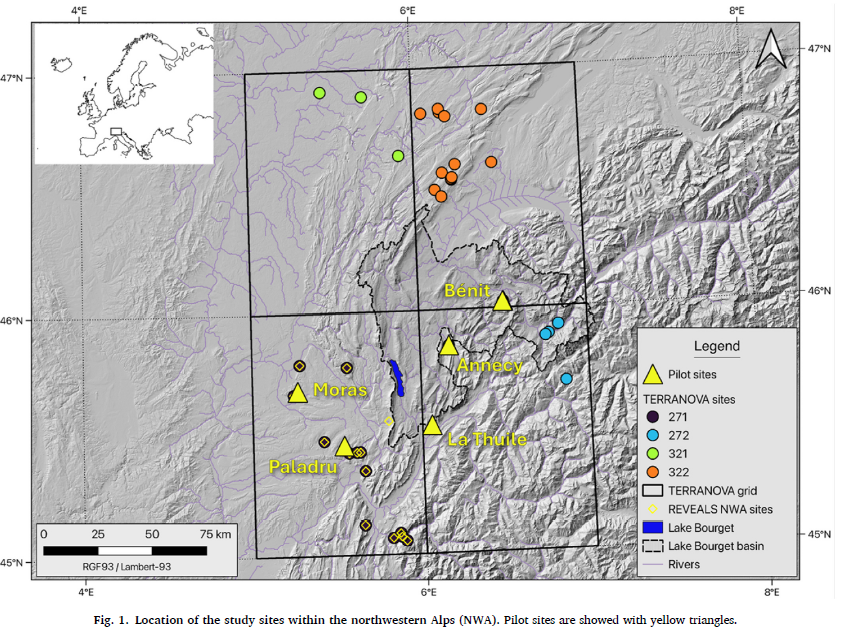
In this study, we investigate the link between soil erosion and land openness, and refine erosion estimates during the Holocene in the northwestern Alps via a vegetation abundance model (REVEALS), pollen assemblage data from lake sediment archives, and terrigenous accumulation rates in lakes as a proxy of catchment soil erosion.
Using empirical cumulative distribution functions (ECDF) and correlation tests, we show that erosion indeed follows a nonlinear response to increasing land openness in the northwestern Alps, potentially challenging current model representations and current regional and global erosion estimates.
We attribute this nonlinear relationship to increased incision and remobilization of deeper soils above critical thresholds of increased land openness, as rapid land clearance heightened surface soil vulnerability to hydrological events and erosion processes.
These findings suggest that revisiting erosion models could be crucial to better understand long-term landscape evolution impacts, especially on soil erosion and its potentially significant downstream effects on carbon exports.
However, the long-term link between land openness and erosion remains unclear. Existing soil erosion models assume that contemporary calibrations and current observations of the link between land openness and erosion apply to the past.
However, one may wonder whether large-scale anthropogenic land clearance during the Holocene intensified or not caused soil erosion beyond a linear relationship, partly due, for example, to increased incision processes.
In this study, we investigate the link between soil erosion and land openness, and refine erosion estimates during the Holocene in the northwestern Alps via a vegetation abundance model (REVEALS), pollen assemblage data from lake sediment archives, and terrigenous accumulation rates in lakes as a proxy of catchment soil erosion.
Using empirical cumulative distribution functions (ECDF) and correlation tests, we show that erosion indeed follows a nonlinear response to increasing land openness in the northwestern Alps, potentially challenging current model representations and current regional and global erosion estimates.
We attribute this nonlinear relationship to increased incision and remobilization of deeper soils above critical thresholds of increased land openness, as rapid land clearance heightened surface soil vulnerability to hydrological events and erosion processes.
These findings suggest that revisiting erosion models could be crucial to better understand long-term landscape evolution impacts, especially on soil erosion and its potentially significant downstream effects on carbon exports.