


-
Partager cette page
Does increasing human impact across the holocene result in simplification of vegetation composition and diversity across Europe? A pollen-based spatio-temporal approach
Article co-signé par Florence Mazier
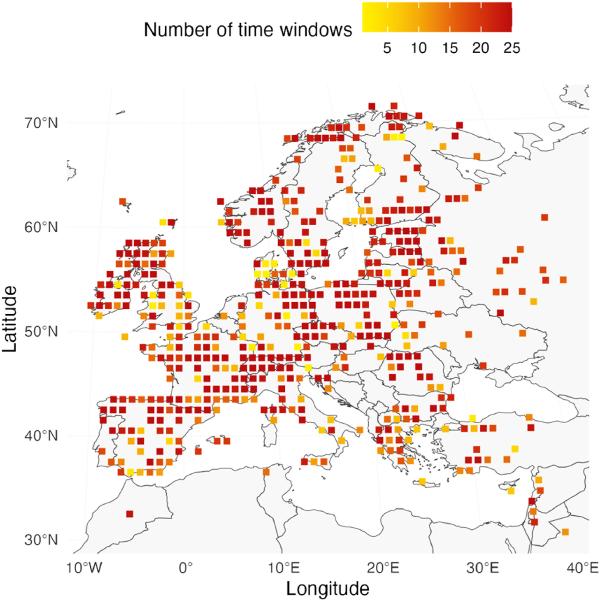
Land use and climate change are the primary drivers of current biodiversity loss, but have had different impacts on biodiversity across the Holocene epoch. To enhance our understanding of current changes in diversity and its impact on ecosystem functions, knowledge of long-term interactions between vegetation diversity, land use change, and climatic change is crucial. Grid-cell estimates of quantified regional vegetation cover (RVest) based on pollen data from 1607 sites across Europe, transformed using the REVEALS (Regional Vegetation Estimates from Large Sites) model, have been used to explore spatiotemporal changes in vegetation and regional diversity during the Holocene (25 time windows covering the period from 11.7 ka cal BP to present). Space-time constrained clustering of the RVests identified six dominant vegetation types (VTs): Mediterranean vegetation, open vegetation, Abies-Fagus forest, broadleaved mixed forest, coniferous mixed forest, Betula woodland, whose spatial extent changes over the Holocene.
The study explored REVEALS α-diversity (richness of taxa, richness of abundant taxa, and evenness) within each grid cell as well as spatial REVEALS β-diversity (spatial variations in composition within one time frame) and turnover (temporal variation in composition within one grid cell) within each vegetation type. Changes in location, size, taxa composition, and REVEALS diversity of the vegetation types characterised four phases during the Holocene. The first (pioneer: 11.7–9.2 ka cal BP) and second (summer-green forest: 9.2 ka to 5.2 ka cal BP) phases generally showed higher REVEALS β-diversity and lower REVEALS evenness. The third phase (mixed semi-natural forest: 5.2 ka to 1.7 ka cal BP) is characterised by expansion of open vegetation and reflects increased human impact on the environment caused by increasing use of land for agricultural production.
The final phase (from 1.7 ka cal BP) saw rapid transformations: open vegetation not only expanded, but also shifted in composition, with major increases in cereals and other anthropogenic indicators. This signals a clear intensification of land-use impact over the last two millennia. Across central Europe, vegetation became increasingly homogenised, dominated by a few widespread species. As a result, both REVEALS evenness and spatial β-diversity plummeted—marking a profound loss of ecological complexity.
In short, human-driven landscape openness did not simply reshape the vegetation—it rewrote the rules of diversity across the continent.
Lire l'intégralité de l'article sur le site sciencedirect.com
