


-
Partager cette page
Assessing the benefits of part-night lighting on a tropical bat species endemic to Reunion Island
Cosigné Samuel Challéat
Turning off lights earlier through Part-Night Lighting effectively reduces ALAN impacts on an endemic bat species’ activity.
Artificial light at night (ALAN) is recognised as an emerging threat to global biodiversity but no technical mitigation strategy can prevent all impacts on ecosystems. Consequently, the most effective measure remains turning-off lights whenever and wherever possible.
However, few studies, all carried out in temperate environments, assessed the effectiveness of Part-Night Lighting (PNL) and the benefits that might result from changes in switch-off times. On the tropical Reunion Island, where ALAN is increasing exponentially, we assessed the sensitivity of an endemic bat species (Mormopterus francoismoutoui) to light, and the effectiveness of PNL in reducing the potential impacts on this species.
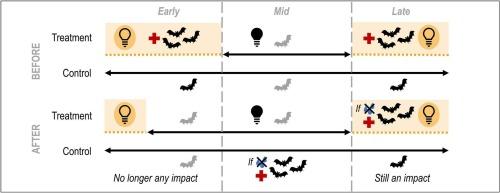
We took advantage of the modification of an existing PNL during a month-long event, consisting in switching off lights two hours earlier than the rest of the year. By carrying out an acoustic monitoring of bat echolocation calls, using a Before-After Control-Impact Paired protocol, we showed that bats were attracted to lit sites, especially at the beginning and end of the night.
When the lights were switched off earlier in the evening, there was no longer any impact on bat activity and rhythm, although a tendency toward greater activity at the end of the night in lit sites persisted in clear weather.
This provides important insights, encouraging extensive use of PNL, ideally with even earlier switch-off times, as a promising measure for mitigating ALAN effects on this endemic species whose overall population vulnerability is still unknown.
Pour lire l'intégralité de l'article, rendez vous sur la page web de https://www.sciencedirect.com/