


-
Partager cette page
Alice OUVRIER
PhD candidateTaught academic discipline(s)
Pastoralism and Bears in the Pyrenees: towards a human/non‑human geography
- Supervisor: Sylvie GUILLERME
- Co‑supervisor : Ruppert VIMAL
Research topics
COEXISTENCE: a geographical definition based on the relationship between pastoralism and bears in the Pyrenees
I. General Introduction of the Thesis
Context :
Several disciplinary fields have taken up the study of coexistence and/or conflict between humans and wildlife in order to account for their social, economic, political, philosophical, psychological, ecological, etc., impacts. This thesis aims to illustrate the extent to which geography, and in particular animal geography, makes it possible to grasp in the field the interactions between humans and wildlife. Indeed, geography is by essence interdisciplinary, suited to the study of living and non‑living elements, situated in space and time and through flexible scales starting from the individual.
Research Question::
Based on the case study of the relationship between bears and pastoralism in the Pyrenees at a micro‑local scale, what geographical and field‑based definition can be given of a coexistence currently under construction?
Thesis Outline:I. Trajectories of Coexistence
II. From the Invisible to the Manifest: interactions between bears and pastoralism on the Pyrenean summer pastures
III. From Conflict to Coexistence: a qualitative approach beyond numbers
IV. A hybrid community involves multispecies interactions (optional chapter)
The first chapter is an invitation to take into account a scale integrating the individual, since the individual is decisive in the construction of a unique trajectory of coexistence. By taking a step back through a temporal scale that includes the arrival of the bear on the summer pastures, this chapter also shows the dynamic and continuous nature of coexistence induced by the arrangements of actors.The second chapter will nuance the definition of coexistence through different points of view based on various sources of information on the presence of the bear, more or less accessible, more or less manifest.Finally, the third chapter makes it possible to discuss our attachment to using the term coexistence rather than conflict, because it allows, through a qualitative approach, a finer grouping of all the components of the relationship between bears and pastoralism, ranging from those usually mentioned in HWC studies to others specific to all interspecific interactions. The final chapter, if included, contextualises the coexistence relationship between pastoralism and bears in relation to those with other species on the summer pastures. Indeed, these territories are necessarily shared among numerous species, illustrating several ways of coexisting.
II. Trajectories of Coexistence
This article is based on a geographical approach that takes into account different actors at the scale of the individual on three Pyrenean summer pastures, and on the opportunity to study a relationship under construction through a temporal scale that includes the arrival of bears on the summer pastures. It highlights the role of the arrangements between these human actors (shepherds, livestock farmers, OFB agents, etc.), non‑human actors (bears, ewes, livestock‑guarding dogs), and equipment (night and care enclosures, huts, scaring devices), as well as their practices, in the construction of unique and dynamic trajectories of coexistence.
III. From the Invisible to the Manifest: interactions between bears and pastoralism on the Pyrenean summer pastures
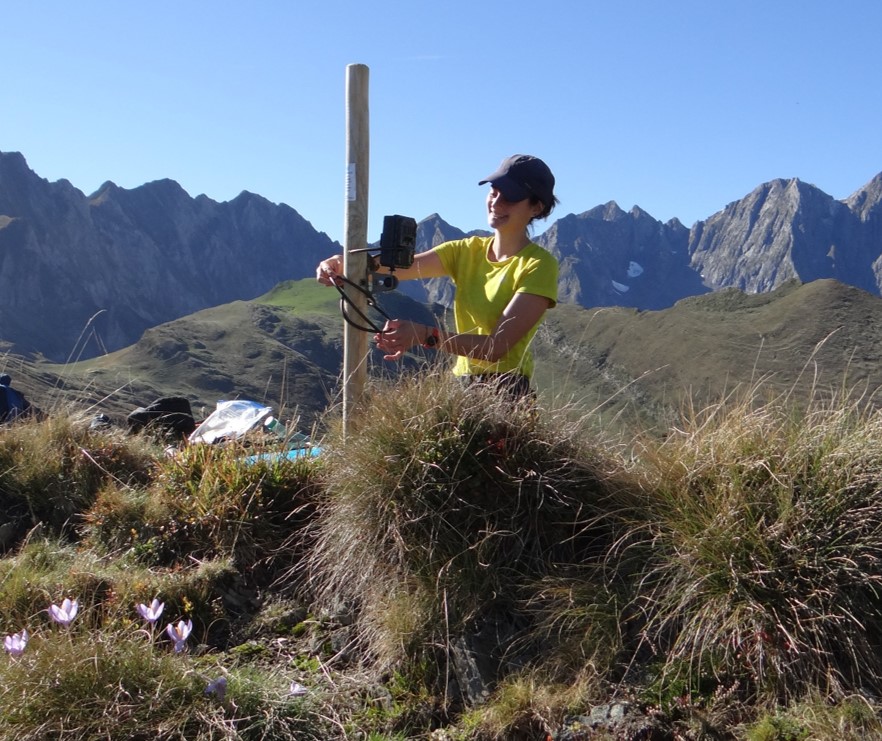
By revealing what is ordinarily invisible, in two years the camera‑trap system has already shown the extent to which the three summer pastures are frequented by bears (284 bear captures, and on average, bear presence on 53% of the camera traps, 21% of the nights and 70% of the weeks of the study period). This technological deployment thus enables us to map in detail the presence of ewes and bears (figure below) and to observe the evolution of their use of the area over time. But by combining this with other sources of information such as predation data, national bear‑monitoring data, and the accounts of livestock farmers, shepherds and managers (Local Ecological Knowledge), how is a summer pasture shared between bears—such discreet animals—and pastoralism? What sources of information are available to detect the presence of a discreet animal? Finally, how can these different points of view be combined to enrich the definition of coexistence?
IV. From Conflict to Coexistence: sensitive approach beyond numbers
Studies of human–wildlife conflict (HWC) often focus, on the one hand, on the social conflict “between humans” and, on the other hand, on the impacts generated by these HWC. They tend to generalise situations and promote large‑scale solutions such as the implementation of protection measures and compensatory schemes.In this chapter, our aim is to take into account other facets of the relationship between humans and large carnivores in these situations, since beyond measurable damage, the relationship between humans and bears on the summer pastures is also based on a mutual and continuous learning process integrated into the actors’ daily lives. These elements support the use of the term coexistence rather than conflict to describe these interspecific relationships.
V. Hybrid community involves multi‑species interactions (optional chapter)
By considering each summer pasture as a hybrid community, it seems important to us to contextualise the interactions between bears and pastoralism in relation to other multi‑species relationships specific to the Pyrenean mountain ecosystem. Thus, thanks to the camera‑trap system, we wish to analyse the spatio‑temporal data collected on other animal species in order to highlight their spatio‑temporal uses. These data could be supplemented by data from other interviews focused on this question. This would involve, for example, describing the relationship of pastoral actors to other animal species.For instance, there is an interesting link between shepherds and vultures, which paradoxically are useful to them for detecting predation events and are also accused of attacking flocks. Some species therefore appear to be taken into account by pastoral actors, while others are completely ignored. This chapter could thus document the “right place of animals” described by pastoral actors, and the place they occupy as revealed by the camera traps.
Activities / Resume
EXPERIENCES :
June to December 2020: Civic Service, Association Dissonances- Pastoralism and Bears in the Pyrenees
- Preliminary work prior to the PhD
March to May 2020: Civic Service, Biosphère Environnement
Monitoring of bird populations in the Gironde estuary
- Literature review, development and implementation of protocols
- Captures, ringing, GPS tagging and listening points
- Statistical analyses (R), accelerometry and GPS tracking (Google Earth)
January to June 2019: Master 2 Internship, CNRS‑SETE
Personality of the Great Tit: link with environment, cognition and social competence
- Literature review, development and implementation of protocols, writing of a thesis and oral defence
- Capture, handling and care of birds
- Behavioural tests (neophobia, exploration, social behaviour) and cognitive tests (associative learning)
- Video analyses (BABAS) and statistical analyses (R)
April to June 2018: Master 1 Internship, ISA Lille & INRA du Magneraud
Relationship between the exploratory temperament trait and working memory in free‑range chickens
- Literature review, development and implementation of protocols, writing of a thesis and oral defence (M1 internship)
- Scientific poster at the SFECA 2019 conference and article in preparation
- Handling and care of birds
- Behavioural tests (scan sampling and open‑field) and cognitive tests (matching‑to‑place)
- Video analyses and statistical analyses (R)
Volunteering :
- Vitrezay ringing camp 2019 (14 days, BioSphère Environnement): assistant ringer
- Occasional ringing assistance: black‑headed gulls (CEFE), tits (SETE), Eurasian woodcocks (FDC 42)
- Montagu’s Harrier campaign 2018 (3 weeks, LPO Isère): nest surveys and protection, observations, counts, care of juveniles
- European Hare population monitoring (FDC 42): IKA counts
- Treasurer of the student association “Fed’Cup” (9 months, USMB)
- Tutoring support (5 months, association “Entraide Jeunes 74”)Support Project in Science and Technology in Primary School (9 months, Chambéry)
CURSUS UNIVERSITAIRE :
- 2020 - 2023 : PhD, CNRS GEODE‑UT2J
- 2017 - 2019 : Master in Ethology and Ecology, Université Jean Monnet (42)
- 2018 :University Diploma BioAcoustic Winter School, ENES, Université Jean Monnet (42)
- 2015-2017 : Bachelor’s Degree in Biology and Ecology, Université Savoie‑Mont Blanc (73)
- 2014-2015 : First year of CPGE BCPST, Lycée Thiers (13)