

-
Partager cette page
The illusion of control: Do we need dark infrastructures to address light pollution?
Co written by Samuel Challéat
This article critically examines how Dark Infrastructure has become a dominant policy tool for addressing the ecological impacts of artificial light at night (ALAN), arguing that more adaptive, participatory, and territorially grounded approaches are needed to reduce light pollution at its source and support nocturnal ecosystems.
The spread of artificial light at night (ALAN) has become a growing concern in conservation science and environmental governance. In France, the Trame Noire policy (TNP) was introduced as a spatial response to ALAN's ecological effects and institutionalised through the concept of Dark Infrastructure (DI). Framed as a science-based, data-driven solution, DI embodies a technocratic vision of environmental control, reducing the complexity of nocturnal ecologies to zoning tools, cartographic templates, and optimisation algorithms.
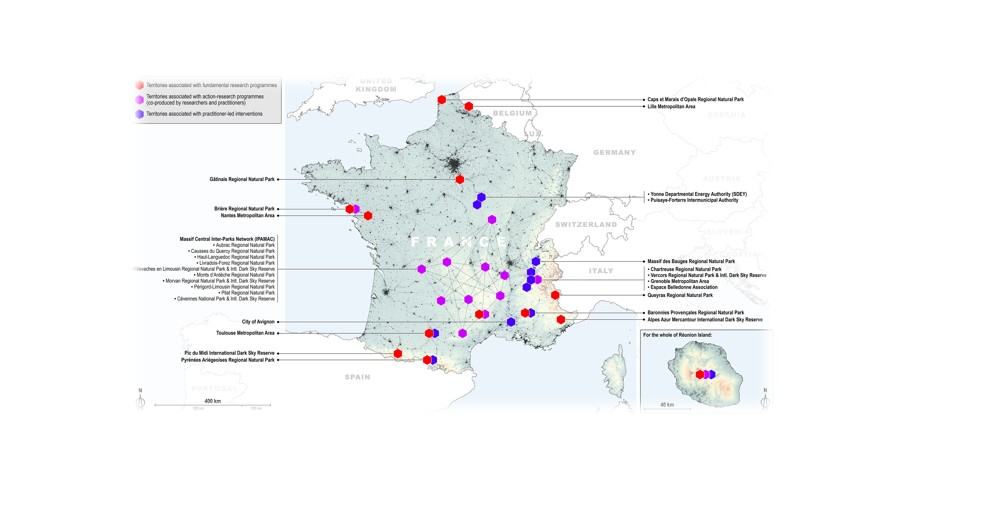
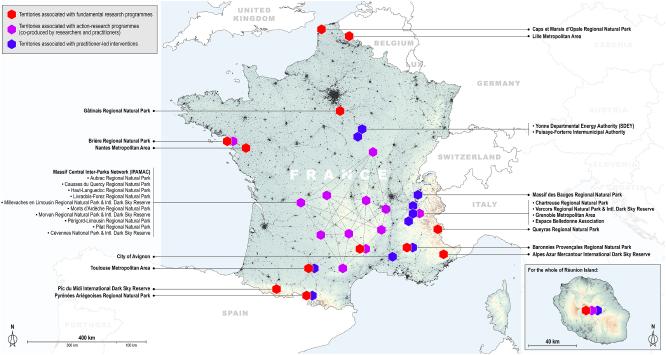
Drawing on a decade of situated fieldwork and research-action programmes, this article adopts a constructivist and critical policy approach to analyse how scientific knowledge is translated into planning instruments. We show how DI, as a policy device, standardises darkness, marginalises local ecological and social knowledge, and promotes a narrow, depoliticised intervention logic.
Far from transforming lighting practices or power relations, DI often consolidates existing infrastructural norms and spatial routines. To move beyond this epistemic and political dead end, we mobilise the concept of Dark Ecological Network (DEN) as a strategic horizon for adaptive and territorially grounded governance. We also introduce the Lit Infrastructure (LI) as a situated logic of action that emphasises stakeholder engagement, collective deliberation, and infrastructural restraint. Rather than engineering darkness through technocratic fixes, this approach focuses on reducing ALAN at its source by questioning lighting norms, dismantling excessive illumination, and enabling territorial experimentation.
This shift reframes darkness not as an object to be designed and controlled, but as a condition to be collectively reclaimed through democratic negotiation, care, and spatial retreat of ALAN. In doing so, we contribute to outlining an ecology of withdrawal—an alternative approach to environmental governance grounded in infrastructural downscaling, situated action, and the reconfiguration of normative spatial interventions.
The full article is available on the website https://journals.sagepub.com/