


-
Partager cette page
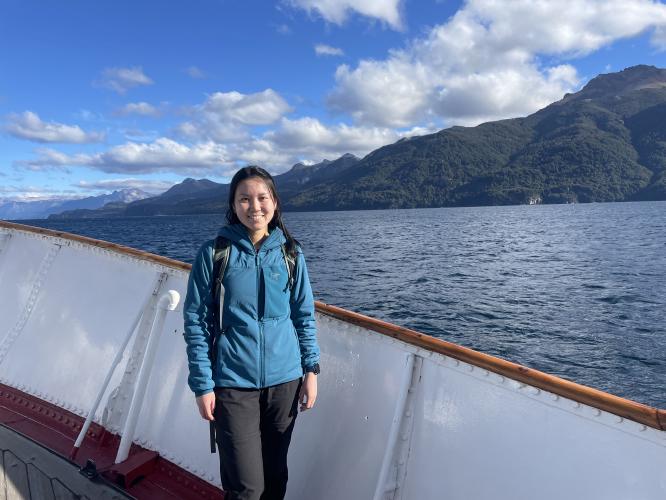
Naomi Cretton
PhD candidateContact details
- Address
- Maison de la Recherche, Jean Jaurès University 5, Allées A. Machado – 31058 TOULOUSE Cedex 1
- Office
- C232
- Phone
- 06 51 93 69 27
- naomi.cretton@univ-tlse2.fr
Body
PhD candidate
Research topics
PhD thesis :
Dynamics of Quaternary sedimentary environments and hydrosystems of the Pyrenean foothills during the deglaciation of the upper Garonne valley- GEODE supervision : Emmanuel Chapron
- BRGM supervision : Bernard Monod and Hélène Tissoux
Abstract :
The Adour‑Garonne basin is expected to be the most affected of the six French river basins in the face of climate change. The estimated water deficit would be more than 2 billion m³ and would become, by 2030, a limiting factor for populations and economic activities, with dramatic consequences for aquatic environments, wetlands and biodiversity.This PhD project, focused on the upper Garonne sector, proposes to study the major glacial valleys of the foothills of the French Pyrenees, which have a high aquifer potential. The objective of this work is to establish a time‑constrained sedimentological model of the dynamics of glacial, post‑glacial lacustrine and fluvial sediment infilling.
This model will be based on a geomorphological and geophysical mapping of the superficial formations of the Garonne valley, as well as on a selection of glacial overdeepenings and thresholds at higher altitude. It will also be calibrated using boreholes and sedimentological and geochronological analyses (e.g., 10Be, 14C & OSL) of glacial, lacustrine and fluvioglacial formations.
Context :
Quaternary deposits formed in glacial overdeepening zones may contain natural groundwater resources. This type of aquifer is considered strategic in the Alps, where it is used for drinking water supply. As a result, they are of real interest due to their position close to socio‑economic issues, within the major valleys where most of the mountain population lives. Thus, it is important to quantify the resource of the Pyrenean glacial valleys, with a view to sustainable groundwater management in the Adour‑Garonne basin, expected to be the most affected of the six metropolitan river basins with regard to climate change.To address this question, it is necessary :
1) to quantify the overdeepening (overdeepened basin) relative to the glacial threshold zones, and
2) to determine the succession and sedimentary geometries deposited in the main valleys from upstream areas to downstream areas.
This thesis aims to better understand Quaternary sedimentation in the Pyrenean glacial valleys in relation to the deglaciation of the French Pyrenees since the Last Glacial Maximum. It therefore concerns the spatial and temporal organisation of environments containing glacial, lacustrine and fluvial sedimentary deposits.The aim will be to propose a depositional model for the infilling of the Garonne valley after glacier retreat, in order to understand how sedimentation is organised in a basin composed of several sub‑basins (and glacial thresholds) and how the transition from deltaic lacustrine sedimentation to fluvial sedimentation occurs. This model will then be used by BRGM hydrogeologists to estimate the groundwater resource in the valley‑fill deposits (aquifer potential of the subglacial trough, deltaic sedimentation, and/or slope inputs).
The main objective of the thesis is therefore to establish a chronological sedimentological model of the dynamics of glacial, then post‑glacial lacustrine and fluvial sediment infilling in the major glacial valleys of the foothills of the French Pyrenees, where aquifer potential is expected.
Activities / Resume
- 2025 – present : PhD in Geoscience – BRGM / GEODE
- 2023 – 2025: Master’s degree in Oceanography – Institut des sciences de la mer (ISMER), Université du Québec à Rimouski (UQAR)2019
- 2023: Degree in Geological Engineering – Polytechnique Montréal
Master’s thesis
Cretton, N. (2025). Reconstruction of Holocene earthquakes based on the analysis of sediment cores from marine and lacustrine basins, Argentine and Chilean Patagonia. ISMER‑UQAR.
Publications extraites de HAL affiliées à Geode : Géographie de l'environnement
Additional information
Conference presentations :
Provincial (Québec)
- Cretton N., St‑Onge, G., Chapron, E., Foucher, A. (2025). Holocene earthquake‑triggered turbidites from the Reloncaví Fjord, northern Patagonia, Chile. Annual Scientific Meeting of Québec Océan, Rivière‑du‑Loup (Canada), 26–27 February 2025 (poster).
- Cretton N., St‑Onge, G., Chapron, E., Villarosa, G., Dominguez, L., Foucher, A. (2025). Holocene earthquake‑triggered turbidites from the Reloncaví Fjord (Chile) and traces of the 1960 Great Chilean earthquake in Argentine lakes. GEOTOP Student Conference, Montreal (Canada), 14–16 March 2025 (poster). Award for Best Poster.
International :
- Cretton N., St‑Onge, G., Chapron, E., Villarosa, G., Dominguez, L., Foucher, A. (2025). Holocene paleoseismic record in the Reloncaví Fjord (Chilean Patagonia) and evidence of the 1960 AD Great Chilean earthquake in Argentine lakes. International Meeting of Sedimentology of the International Association of Sedimentologists, Huelva (Spain), 26–28 June 2025 (poster). Best Poster Award in the Early Career Scientist Competition.
- Cretton, N., St-Onge, G., Chapron, E., Villarosa, G., Dominguez, L., Foucher, A. (2025). Holocene paleoseismological record from the Reloncaví Fjord (Chile) and evidence from the 1960 AD Great Chilean earthquake in proglacial Lakes Frías and Mascardi (Argentina). 3rd Paleolimnology & Limnogeology International Symposium, Aix-les-Bains (France), 6–10 October 2025 (poster).